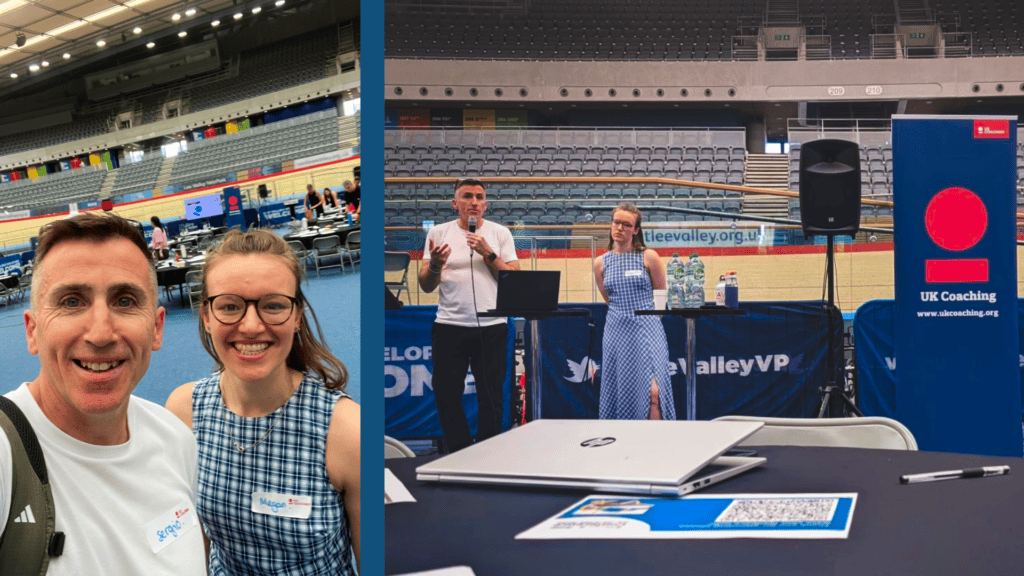
Protecting coaches means protecting children. That was the powerful message shared at this year’s UK Coaching Summit, where researchers from Leeds Beckett University presented new findings exploring one of the biggest challenges facing sport: why coaches decide to walk away.
At the iconic Lee Valley VeloPark in London, Professor Sergio Lara-Bercial (also Vice President, Strategy and Development, of the International Council for Coaching Excellence) and Dr Megan Hill delivered an interactive keynote examining why coaches stop coaching. Drawing on emerging research, they invited delegates to reflect on their own coaching experiences and consider what it will take to better support, value and retain coaches across the sporting landscape.
Bringing research to life through shared experiences, delegates were encouraged to connect their own coaching journeys with the wider findings and reflect on the factors that shape coaches’ decisions to stay in—or leave—the profession. The session challenged participants to think collectively about how the coaching community can better support, value and sustain coaches at every stage of their journey.
The research challenges the common assumption that coaches leave because of a single frustrating incident. Instead, the findings suggest that coach dropout is often the result of a gradual breakdown in the relationship between coaches and the systems that rely on them.
“The legal contract may still exist,” explained the researchers, “but the human contract has often been broken.”
For thousands of volunteer and paid coaches working with children and young people, coaching involves far more than delivering sessions. Coaches invest their time, energy, expertise and emotional commitment. They support participants, communicate with parents, fulfil safeguarding responsibilities, organise activities and frequently give up evenings and weekends to create positive sporting experiences.
In return, they expect something equally important: meaningful support, respect, clear expectations, opportunities to develop, fair treatment and realistic demands.
When that balance disappears, leaving coaching becomes a rational decision rather than an unexpected one.
One quote from the research captured this perfectly:
“It wasn’t the straw that broke the camel’s back. The camel was already broken.”
Rather than viewing coach dropout as an individual issue, the research argues it should be understood as a systems challenge.
For organisations committed to developing positive experiences for children, this has significant implications. Recruiting more coaches will have limited impact if the environments they enter continue to place excessive demands on them. Retention, not just recruitment, must become a strategic priority.
The researchers propose building a stronger “coach retention architecture”, including:
- Better support and wellbeing provision.
- Mentoring, supervision and opportunities for reflection.
- Reduced administrative burden.
- More realistic coaching roles and expectations.
- Fairer financial support where appropriate.
- Greater assistance in managing parent relationships and club culture.
- Flexible pathways that allow coaches to pause, return, mentor or move into different roles.
- Recognition of coaching as essential sport infrastructure.
These recommendations strongly align with the values of ICOACHKIDS, which advocates for child-centred coaching environments that also recognise the importance of supporting the adults who make positive youth sport possible.
Healthy, motivated and well-supported coaches are better able to create safe, enjoyable and developmentally appropriate experiences for children. Investing in coaches is therefore not simply about workforce development—it is fundamental to protecting the quality and sustainability of children’s sport.
The full research report will be published soon by UK Coaching, providing further insights into how organisations can better support and retain their coaching workforce.
As the keynote concluded, protecting coaches is not separate from protecting participants. The two are inseparable.
When coaches thrive, children benefit.